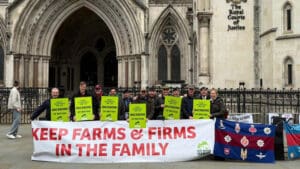

Farmers and business owners have launched a High Court challenge against the government’s inheritance tax reforms, arguing that ministers acted unlawfully by failing to properly consult on changes that could reshape the future of family-run enterprises.
The two-day judicial review, which began on 17 March at the Royal Courts of Justice, will examine whether Chancellor Rachel Reeves breached established consultation principles when altering Agricultural Property Relief (APR) and Business Property Relief (BPR).
The case has been brought by Cambridgeshire farmer Tom Martin, alongside his father George Martin and campaign group Farmers and Businesses for Fair Tax Relief. The claim is supported by law firm Collyer Bristow on behalf of advisory firm Alvarez & Marsal.
At the heart of the legal argument is the government’s Tax Consultation Framework, introduced in 2011, which commits ministers to conducting at least one formal public consultation on major tax reforms. The claimants argue that the inheritance tax changes, which affect how farms and businesses are passed down through generations, clearly meet that threshold but were introduced without meaningful engagement.
Speaking ahead of the hearing, Tom Martin said he had been forced to leave his farm work to pursue legal action, describing the case as a fight for fairness. Outside the court, campaigners gathered under banners reading “Keep Farms and Firms in the Family”, highlighting growing unrest across rural and business communities.
Under the proposed changes, due to take effect from April 2026, inheritance tax relief will be structured as follows:
• 100% relief on the first £2.5 million of qualifying agricultural and business assets
• 50% relief on assets above that threshold
• Up to £5 million relief for married couples or civil partners, plus standard allowances
• Any tax liabilities payable over 10 years, interest-free
While the government has positioned the reforms as a balanced approach to taxation, critics argue they could fundamentally alter succession planning for family-owned farms and enterprises.
Legal representatives for the claimants say the absence of consultation has created significant uncertainty.
Alexander Marcham, managing director at Alvarez & Marsal Tax, said many affected businesses have been built over generations and now face difficult decisions without clarity. He warned that the reforms could disrupt long-term planning around succession, investment and ownership structures.
The claimants argue that the failure to consult denied them a voice in policy development, particularly given the scale of the financial and operational implications.
The government is contesting the case, maintaining that judicial intervention would risk crossing into parliamentary territory. However, the claimants counter that the decision not to consult occurred before legislation reached Parliament, making it open to legal challenge.
A ruling is not expected immediately. Judgment is likely to be reserved and delivered in writing within the next few months.
Beyond the immediate tax implications, the case could set an important precedent for how major fiscal policy is developed in the UK. If the court finds in favour of the claimants, it may reinforce the requirement for formal consultation on significant tax reforms, potentially reshaping how future budgets and policy changes are introduced.
For now, however, farming families and business owners remain in a state of uncertainty, awaiting a decision that could have lasting consequences for generational wealth, rural economies and the broader business landscape.
Read more:
Farmers launch High Court challenge over inheritance tax reforms amid consultation row